WEBINAR
Managing Your Aging Workforce
Thursday, November 19
1:00 p.m. (Eastern)
Baby Boomers – the huge generation born between 1946 and 1964 – are now aged 62-80. Generally divided into two groups, the oldest cohort are largely retired but still partly in the workforce as some take part-time jobs. But the youngest cohort aged 62-71 often have chosen not to retire for reasons that range from insufficient retirement savings to having reached their peak earning and expertise years. That delay in exiting the workforce sometimes creates friction between generations – especially the two generations right after the Boomer years that are now competing for promotions.
And most members of those three generations are currently over age 40 or close. That means your workforce includes a large number of employees covered by the Age Discrimination in Employment Act (ADEA) and other federal laws protecting older workers from discrimination, harassment and unfair denial of benefits. What’s more, it’s not just discrimination based on being older than 40 that’s protected – it is relative discrimination based on age within generations too, pitting 40+ year old workers against those in their 50s, 60s, 70s and up.
But wait, there’s more. As workers age, they frequently develop disabilities. And these confer rights under the Americans with Disabilities Act (ADA) to reasonable accommodations designed to allow older, disabled workers to continue working. Employer concerns about rising medical costs aren’t relevant and can’t be used as an excuse to cut older workers during a company-wide restructuring, for example.
On Thursday, November 19, get all your questions about managing an aging workforce answered, including managing inter-generational conflict while following federal, state and local laws designed to protect older workers from discrimination based on their age and disability.
WEBINAR AGENDA:
- Generational conflict and age discrimination. Learn all about managing a multi-generational workforce for harmony, productivity and fairness while following the law.
- The ADEA. The law isn’t kind to employers that discriminate, segregate or allow harassment based on age. Supervisor training is key.
- Layoffs, restructurings and terminations. Learn all about what you can and cannot do to encourage older workers to step aside during major workforce reductions.
- The Older Worker Benefits Protection Act (OWBPA). Running afoul of this federal benefits protection law can cost the company millions. Learn how to comply.
- The Americans with Disabilities Act. As we age, we develop disabilities. Learn about the most common age-related ones and how to accommodate them.
- Preventing ageism and harassment. Learn how to prevent and stop ageist harassment that crosses the line between good-natured ribbing and harassment based on age.
- Access to training. Discover why it’s critical you don’t assume older workers don’t need or don’t deserve training or promotions despite approaching their retirement years.
✔ Managing intergenerational conflict. All about keeping the peace while promoting and training staff across generations.
✔ The ADEA and age discrimination. It’s more complicated than you think, requiring you to balance company needs and age discrimination prevention.
✔ Layoffs and reductions in force. Don’t get tripped up when having to cut older workers. It’s possible if you do it right.
PRESENTED BY:

Anniken Davenport is a noted employment law attorney and the legal analyst and senior editor of HR Employment Law Advisor. She has authored several books, including the Employer’s Practical Legal Guide and Bullet-Proof Your Employee Handbook. Anniken has served as a professor at Penn State University, where she taught business law and HR management, and she directed the Legal Studies Program at Wilson College.
REGISTRATION BONUSES:

Everyone who signs up will receive a copy of our white paper Managing Across Generations. Today’s workplace spans four distinct generations, each bringing unique perspectives, work styles and expectations. Learning to manage across these cultures can mean the difference between a cohesive team and a fractured one.
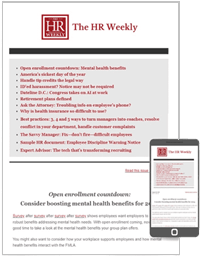
You’ll also receive one month of exclusive access to The HR Weekly, our comprehensive service with all the HR advice and compliance tools to simplify your job … and to keep your organization out of court. So that you continue to benefit from The HR Weekly, we will continue your subscription after that for the then current rate, unless you tell us “no, thanks”—your choice.
RECERTIFICATION CREDITS:

Business Management Daily is recognized by SHRM to offer Professional Development Credits (PDC) for SHRM-CP® or SHRM-SCP® recertification activities.
This Program has been pre-approved for 1.25 HR (General) credit hours toward aPHR®, aPHRi™, PHR®, PHRca®, SPHR®, GPHR®, PHRi™ and SPHRi™ recertification through HR Certification Institute® (HRCI®).
Save 90% on a Complete Year of Training Webinars
Train Big. Save Big. Win Big.
Access around 100 live, expert-led training sessions each year… for just $1,599

WE PROMISE YOU’LL BE SATISFIED:
If this webinar fails to meet your needs in any way, we will refund 100% of your tuition – every penny you paid – but your course materials and registration bonuses will be yours to keep. No hassles, no questions asked.

P.O. Box 9070, McLean, VA 22102
Copyright © 2026 • Business Management Daily • All rights reserved