WEBINAR
Inclement Weather Policies:
Best Practices for Employers
Thursday, November 5
1:00 p.m. (Eastern)
“Neither snow nor rain nor heat nor gloom of night stays our employees from the swift completion of their appointed tasks”
Weather disasters seem to be happening more often these days. While there is robust debate on exactly why weather patterns are changing, one thing is certain; Whenever floods, blizzards, tornadoes, wildfires or other weather phenomena strike, employees can’t always make it to work. Bridges may be out, roadways blocked and public transportation canceled. As an employer, how do you manage? Do you shut down operations and call it a day or struggle with a skeletal staff that does manage to make it in?
On November 5, get answers to all your questions about inclement weather in this brand-new webinar. Learn who must be paid when they can’t make it in and whose paycheck can be docked. Develop a contingency plan your team can activate quickly depending on weather conditions, saving time and preventing possible workplace catastrophes.
But there’s much more. Depending on the nature of your business, learn all about activating a temporary telework schedule that lets work continue largely uninterrupted for employees who can’t brave the weather but still have power. The key is putting the infrastructure in place before disaster hits.
Finally, understand your obligations under USERRA for those employees who are called up during weather or other emergencies. Thanks to recent Congressional changes to the law, more workers are covered. For example, the Federal Emergency Management Agency (FEMA) has tens of thousands of civilians on call to handle everything from rescues to communication restoration to PR and photography and they all now have workplace protections and the right to return to their regular jobs post-disaster.
WEBINAR AGENDA:
- The FLSA and inclement weather.
Learn when hourly workers must be paid if the worksite remains open—and when they don’t have to be paid. - Exempt workers.
The rules are different for exempt workers. Who must be paid if they perform some work during the week the storm hits? - What about PTO?
We show you when workers can draw on PTO for pay—and when they can’t. - Emergency planning.
Learn when telework is the solution to inclement weather—and when it’s not. - Design a weather protocol.
Don’t leave closing or staying open to chance. Which triggers should automatically activate closing or early departure? - USERRA.
Learn all about this newly revised federal law that may leave you short-handed, and what to do about it.
✔ Who gets paid, who doesn’t. When bad weather blocks roads, public transit stops and workers can’t show, employers must know who should keep drawing a paycheck and who shouldn’t.
✔ When workers disappear. Understanding employee rights under USERRA when weather trouble occurs is more crucial than ever. It’s not just overseas deployments anymore.
✔ Telework to the rescue. Why a robust telework program belongs in your emergency preparedness plans. It’s the best way to keep going in the face of weather emergencies.
PRESENTED BY:

Anniken Davenport is a noted employment law attorney and the legal analyst and senior editor of HR Employment Law Advisor. She has authored several books, including the Employer’s Practical Legal Guide and Bullet-Proof Your Employee Handbook. Anniken has served as a professor at Penn State University, where she taught business law and HR management, and she directed the Legal Studies Program at Wilson College.
REGISTRATION BONUSES:
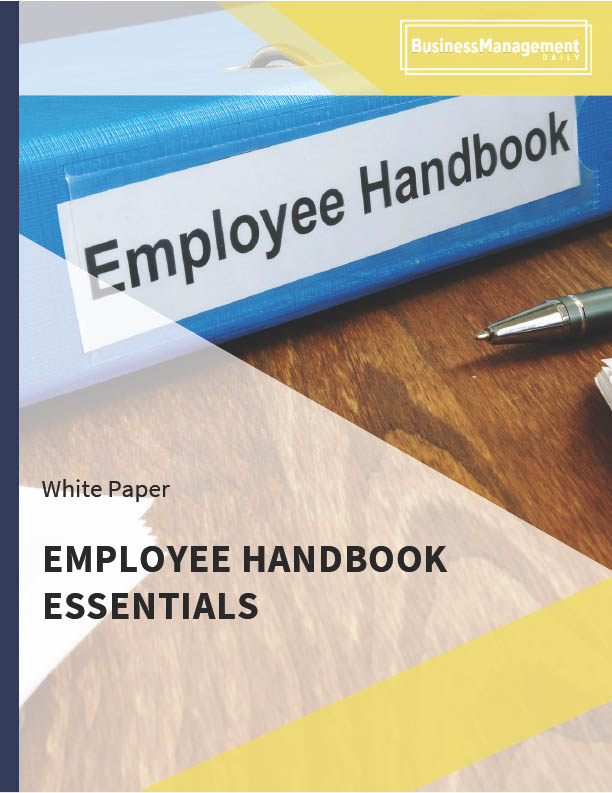
Everyone who signs up will receive a copy of Employee Handbook Essentials. Whether you’re starting from scratch or simply updating your handbook, this white paper will walk you through a foolproof process and provide you with 20 customizable sample policies. Take the guesswork out of one of the most important documents for your organization.
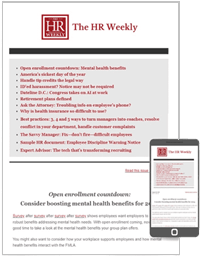
You’ll also receive one month of exclusive access to The HR Weekly, our comprehensive service with all the HR advice and compliance tools to simplify your job … and to keep your organization out of court. So that you continue to benefit from The HR Weekly, we will continue your subscription after that for the then current rate, unless you tell us “no, thanks”—your choice.
RECERTIFICATION CREDITS:
Business Management Daily is recognized by SHRM to offer Professional Development Credits (PDC) for SHRM-CP® or SHRM-SCP® recertification activities.
This Program has been pre-approved for 1.25 HR (General) credit hours toward aPHR®, aPHRi™, PHR®, PHRca®, SPHR®, GPHR®, PHRi™ and SPHRi™ recertification through HR Certification Institute® (HRCI®).
Save 90% on a Complete Year of Training Webinars
Train Big. Save Big. Win Big.
Access around 100 live, expert-led training sessions each year… for just $1,599

WE PROMISE YOU’LL BE SATISFIED:
If this webinar fails to meet your needs in any way, we will refund 100% of your tuition – every penny you paid – but your course materials and registration bonuses will be yours to keep. No hassles, no questions asked.

P.O. Box 9070, McLean, VA 22102
Copyright © 2026 • Business Management Daily • All rights reserved