WEBINAR
Protect Your Business Against PWFA Lawsuits: Essential Steps for Employers
Thursday, May 7 • 1:00 p.m. (Eastern)
It’s your job to reasonably accommodate workers expanding their families or experiencing pregnancy-related challenges while allowing workers to retain their paychecks and health benefits.
The EEOC is trying to impress on employers that it means business when it comes to helping pregnant employees stay on the job while juggling medical appointments, pregnancy complications and other urgent pregnancy-related needs. The onslaught of lawsuits it is filing is proof of that fact. But it’s not just pregnancy—think infertility, stillbirth, early miscarriage, milk expression and other pregnancy-adjacent problems.
Then there’s your legal obligation to find a way for pregnant workers to remain on the job—even if they can’t perform every essential function. It’s your duty to offer reasonable accommodations up until birth, including a light-duty assignment that’s wildly different from their regular job. Simply put, the law says you must do everything reasonable that allows your pregnant employee to keep receiving her paycheck, even if that interferes with running your business.
The demands on employers are onerous, but help is here. We will walk you through a sensible framework that includes training for supervisors using a commonsense guide to accommodating every phase of pregnancy from conception to the postpartum return to work. Included are a checklist and a flowchart outlining the entire process.
On May 7, join employment lawyer Anniken Davenport as she walks you through these new requirements for pregnancy accommodations, how to stay in compliance with the Pregnant Workers Fairness Act and how to safeguard your company against lawsuits.
WEBINAR AGENDA:
- Leave as an accommodation. Understand when leave may not qualify as a reasonable accommodation (rarely) and when it may be required for cases of infertility, miscarriage, stillbirth and more.
- Guaranteed accommodations. Walk away with a checklist of the accommodations the EEOC says you can’t question—no doctor’s note, no forms, no delay.
- Top practical accommodations. Easy-to-implement, detailed, practical accommodations that won’t unduly disrupt the workplace while complying with the law.
- Lessons from the courtroom. Now that lawsuits have gone to court or settled, embrace lessons learned the hard way so you won’t repeat them.
- Compliant break rooms no matter your industry. Walk away with instructions for creating compliant milk-expression rooms for any workplace.
- Postpartum accommodations. Understand the obligations you have postpartum, including how soon you may have to bring new mothers back, even if they still can’t perform every essential function.
✔ How to accommodate infertile, pregnant and postpartum workers.
✔ Lessons learned from PWFA lawsuits.
✔ How to arrange for (unlimited) workplace milk-expression breaks.
PRESENTED BY:

Anniken Davenport is a noted employment law attorney and the legal analyst and senior editor of HR Employment Law Advisor. She has authored several books, including the Employer’s Practical Legal Guide and the FMLA Compliance Guide. Anniken has served as a professor at Penn State University, where she taught business law and HR management, and she directed the Legal Studies Program at Wilson College.
REGISTRATION BONUSES:

Everyone who registers will receive two vital forms related to pregnancy and postpartum. Our Pregnancy Related Accommodation Requests white paper allows employers to document the request and any necessary accommodations. The Lactation Breaks form outlines requirements for employers, a sample policy and a form to use to document arrangement of the breaks.
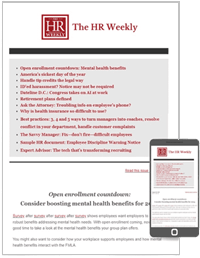
You’ll also receive one month of exclusive access to The HR Weekly, our comprehensive service with all the HR advice and compliance tools to simplify your job … and to keep your organization out of court. So that you continue to benefit from The HR Weekly, we will continue your subscription after that for the then current rate, unless you tell us “no, thanks”—your choice.
RECERTIFICATION CREDITS:
Business Management Daily is recognized by SHRM to offer Professional Development Credits (PDC) for SHRM-CP® or SHRM-SCP® recertification activities.
This Program has been pre-approved for 1.25 HR (General) credit hours toward aPHR®, aPHRi™, PHR®, PHRca®, SPHR®, GPHR®, PHRi™ and SPHRi™ recertification through HR Certification Institute® (HRCI®).
Save 90% on a Complete Year of Training Webinars
Train Big. Save Big. Win Big.
Access around 100 live, expert-led training sessions each year… for just $1,599

WE PROMISE YOU’LL BE SATISFIED:
If this webinar fails to meet your needs in any way, we will refund 100% of your tuition – every penny you paid – but your course materials and registration bonuses will be yours to keep. No hassles, no questions asked.

P.O. Box 9070, McLean, VA 22102 • (800) 543-2055
Copyright © 2026 • Business Management Daily • All rights reserved