WEBINAR
Accommodate or Terminate:
Is it Time to Say Goodbye?
Wednesday, April 15 • 1:00 p.m. (Eastern)
The high-stakes question every employer faces: Accommodate or say goodbye?
You want to be that employer that helps employees achieve work-life balance. But you also need to make a profit and fulfil your organization’s mission. It’s a delicate balance. With an ever-growing list of accommodations, finding the right mix between helping workers thrive and sustaining a business is getting harder.
From pregnancy accommodations to the Supreme Court’s view that almost all religious-accommodation requests must be honored, this process is getting increasingly harder for HR teams. Sometimes, work-life balance tilts too far away from actually getting the work done. Knowing where to draw that line has never been more important.
At what point have you done enough to offer extra leave, revised job tasks, changes to workstations or modified schedules? When are you forced to temporarily eliminate essential functions? When must you say “yes” to such accommodations, when can you say “no” and when is it legal to say goodbye?
Get the details on navigating dangerous legal red lines at Accommodate or Terminate. This webinar covers all your compliance obligations under the ADA, the FMLA, Title VII’s religious discrimination and accommodation provisions, the Pregnant Workers Fairness Act and the PUMP Act.
On April 15, join employment lawyer Anniken Davenport as she provides you with a legal roadmap to work through one of the toughest HR responsibilities, so you can confidently know when it is time to accommodate and when it is time to terminate.
WEBINAR AGENDA:
- Employer do’s and don’ts. Which accommodations are required under the ADA, FMLA, PWFA and PUMP Act.
- Religion. It’s almost impossible to turn down a religious-accommodation request without objective, concrete evidence that making the accommodation will severely impact your bottom line.
- What is a religion anyway? You don’t have to honor them all. The trick is to know what doesn’t constitute a sincerely held religious belief.
- Failed accommodations. What to do when accommodations aren’t working and you’ve tried all reasonable options.
- PWFA and PUMP. These recent federal laws provide extensive pregnancy and postpartum workplace rights that you don’t want to get wrong.
- FMLA vs. ADA. Know the difference between FMLA leave for health issues and reasonable accommodations under the ADA.
- Essential job functions. See exactly what your job descriptions must say about “essential” and non-essential functions.
- Step-by-step interactive process. Find out exactly what you must do (and document) when an employee requests an accommodation.
- Accommodation resources. Discover resources for finding the best possible accommodation for your organization. (Tip: It doesn’t always have to be the one the employee prefers—with one crucial exception.)
✔ Accommodation obligations. Understand your responsibilities under the ADA, FMLA, PWFA, PUMP Act and Title VII’s religious-discrimination provisions—and how to document your decisions.
✔ Recent decisions clarify recent laws. Congress expanded the right to temporary pregnancy and post-pregnancy accommodations, and the Supreme Court ruled on religious accommodations. Learn what to do now.
✔ Lawsuit prevention. Steps you MUST take when receiving disability or intermittent leave accommodation requests—and when you can legally reject the requests and terminate.
PRESENTED BY:

Anniken Davenport is a noted employment law attorney and the legal analyst and senior editor of HR Employment Law Advisor. She has authored several books, including the Employer’s Practical Legal Guide and the FMLA Compliance Guide. Anniken has served as a professor at Penn State University, where she taught business law and HR management, and she directed the Legal Studies Program at Wilson College.
REGISTRATION BONUSES:

Everyone who signs up will receive our white paper Answers to 18 Common ADA Accommodation Requests. Accommodations are an important part of any employer’s job, and not meeting legal requirements for a request may result in serious consequences. It’s crucial to have a firm understanding of what’s expected from HR and leadership when any accommodation request is filed.
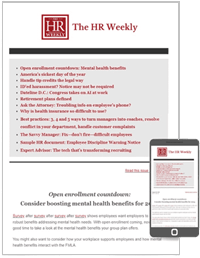
You’ll also receive one month of exclusive access to The HR Weekly, our comprehensive service with all the HR advice and compliance tools to simplify your job … and to keep your organization out of court. So that you continue to benefit from The HR Weekly, we will continue your subscription after that for the then current rate, unless you tell us “no, thanks”—your choice.
RECERTIFICATION CREDITS:
Business Management Daily is recognized by SHRM to offer Professional Development Credits (PDC) for SHRM-CP® or SHRM-SCP® recertification activities.
This Program has been pre-approved for 1.25 HR (General) credit hours toward aPHR®, aPHRi™, PHR®, PHRca®, SPHR®, GPHR®, PHRi™ and SPHRi™ recertification through HR Certification Institute® (HRCI®).
Save 90% on a Complete Year of Training Webinars
Train Big. Save Big. Win Big.
Access around 100 live, expert-led training sessions each year… for just $1,599

WE PROMISE YOU’LL BE SATISFIED:
If this webinar fails to meet your needs in any way, we will refund 100% of your tuition – every penny you paid – but your course materials and registration bonuses will be yours to keep. No hassles, no questions asked.

P.O. Box 9070, McLean, VA 22102 • (800) 543-2055
Copyright © 2026 • Business Management Daily • All rights reserved